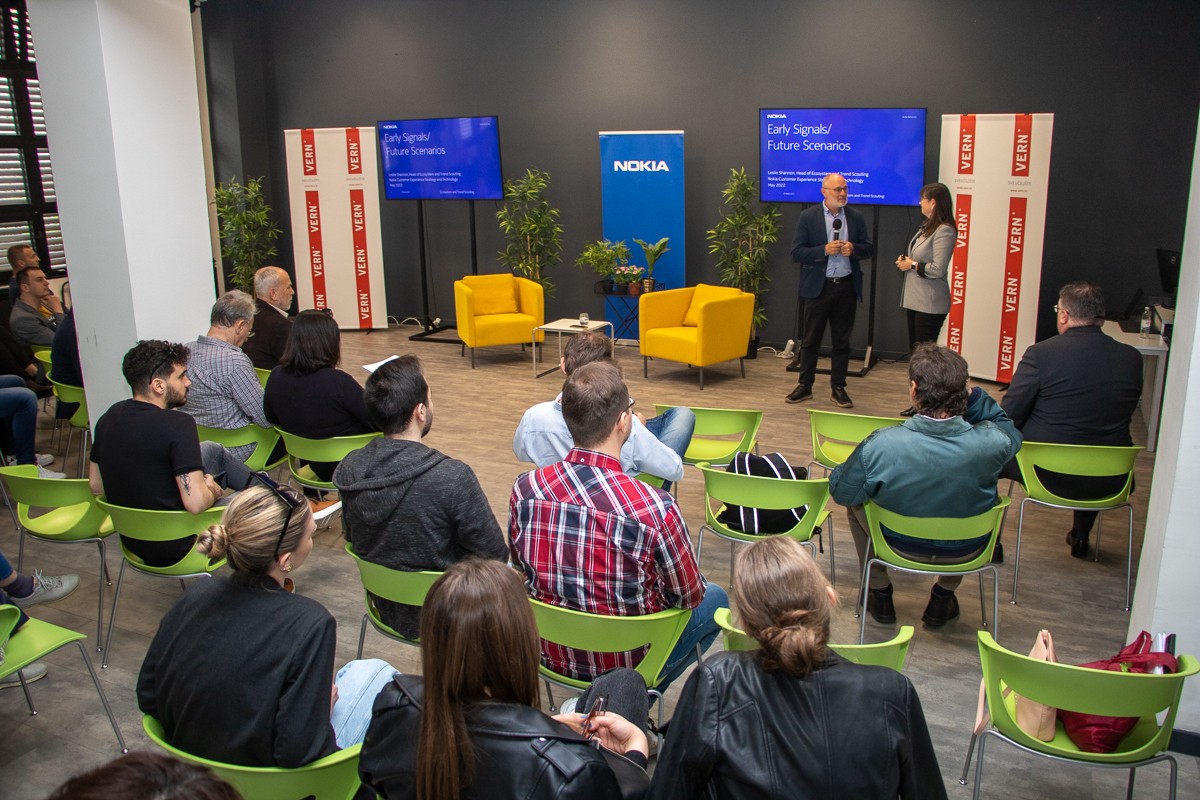
Leslie Shannon, NOKIA's expert in forecasting new technologies and their application, gave a lecture entitled "Early Signals/Future Scenarios" at VERN' University.

"Every new technology solves a specific problem, but it also creates new problems." With these words, Leslie Shanon , Head of Ecosystem and Trend Scouting at NOKIA, began her guest lecture today, organized by NOKIA and VERN' University, entitled "Early Signals/Future Scenarios".
As a renowned global expert for forecasting new technologies and their areas of application, Leslie Shannon noted that the main driver of the wider application of 5G technology was the so-called "split the chip moment", i.e. the moment when corporations became aware that they have to "cut the chips in half" and that 5G technology reduces their logistics expenses, and consumers that the introduction of 5G will simplify their everyday lives.
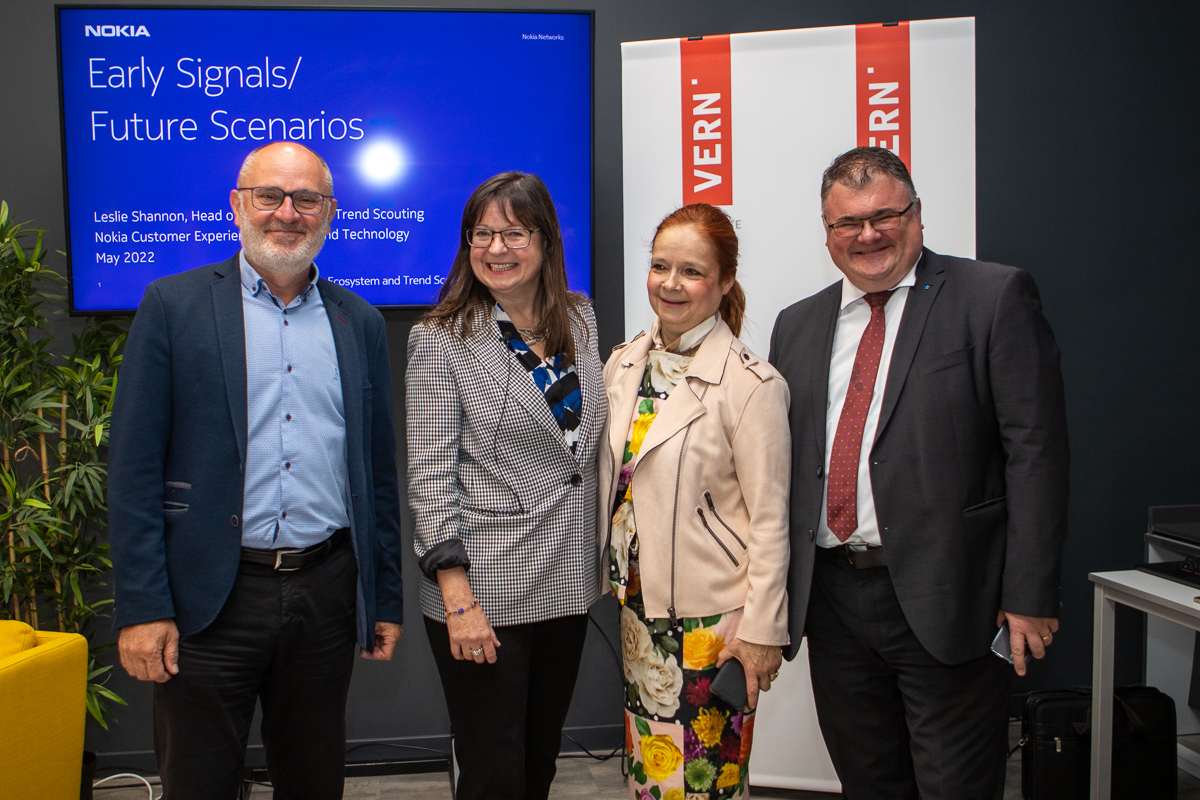
Since the wider application of new technologies always begins in corporations, NOKIA's expert explained the current areas of application of 5G technologies and the benefits they bring to sectors such as telephony, gaming, engineering, transport, healthcare, and even fish farming in Norway or vegetable quality control in aero farms in the USA.
"The application of new technologies always starts in corporations, while consumer applications are still to come and will be much more important, especially in the segment of augmented reality. 4G turned our mobile phone into a viewing device, enabling us with 2D mapping and access to interesting content. 5G will transform our mobile phone into a so-called headset or glasses, mapping will be three-dimensional, and content - only the sky is the limit."
She pointed out that the wider application of 5G technology will have an impact on solving another social problem, which is the so-called social exclusion, because "you will no longer be looking at the screen, but through the screen, and technology will allow you to add context to the content. And that is the twin brother of the metaverse" .
"I believe that by 2030, AR headsets (augmented reality glasses) will replace mobile phones, since it is precisely the metaverse that meets the prerequisites for the development of such an environment: the unification of the physical and virtual worlds, the persistence of avatars across all platforms, a fully operational economy and exchange of goods, compatibility of all platforms regardless of the service provider, and decentralized operations."
Numerous technology giants are already investing billions of dollars in research and development of prototypes in all segments of augmented reality, and among the most generous are Apple, Microsoft, Google, Jio, Meta, Niantic, Snapchat and Amazon.