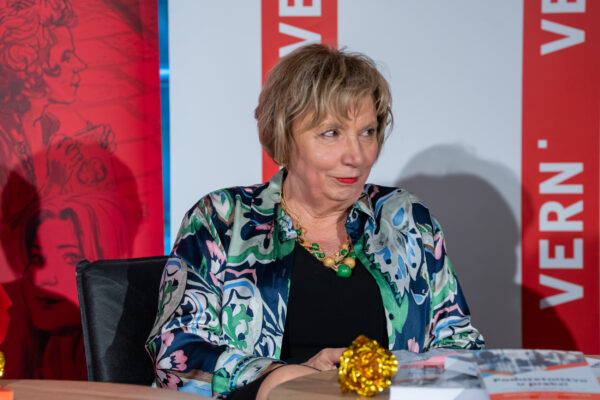
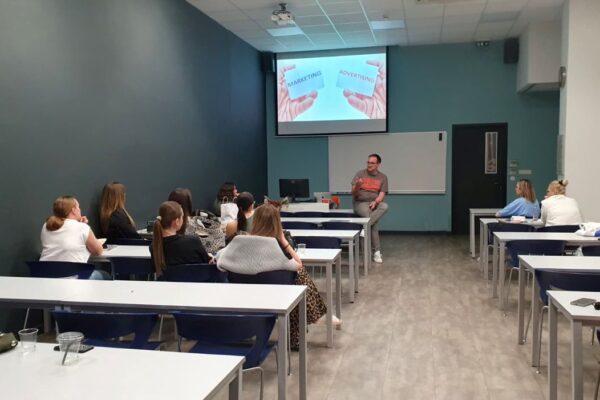
This was an excellent opportunity for our students and lecturer Zlatko Herljević to summarize their experiences from the festival with the guest and discuss his works.

Miro Gavran, one of the most translated and performed Croatian writers and theater authors, recently guest-taught at VERN's undergraduate journalism program , as part of the exercises in the course Complex Journalistic Forms .
Given that the guest appearance took place just a day after his return from Prague, from the unique festival "Gavranfest" dedicated only to works based on his texts, this was an excellent opportunity for our students and lecturer Zlatko Herljević to summarize their experiences from the festival with the guest and discuss his works.
When asked if there is a limit to freedom of speech in art, Gavran replied that there should be a limit everywhere, including in art.
"Our limit is the other person. When I write, I want the person reading it to feel better and more fulfilled. I want to create something that will be a convincing representation of human existence for them. I never have the need to shock another person, hurt them, or make them feel that their limit of beauty, freedom, and what life is, has been crossed in any way. We are not in this world just for ourselves. We as humans only fulfill ourselves in relation to another person," he explained.
When asked if he intentionally shys away from negative and pessimistic topics, he pointed out that he has an affirmative attitude towards life, and this is evident in his works.
"Some writers are very pessimistic, very depressive. They have a right to be - optimism and pessimism are not aesthetic categories. I don't deny anyone the right to introduce darkness into their work, but I'm simply not that. If I wrote that way, I would be deceiving myself, and then also my readers, and that wouldn't be good. I think that in the last 50 years or so, contemporary European art has been moving towards almost appreciating that darkness. I think that it's not fruitful in an artistic sense, and that it's also reached a wall and that the audience is looking for something else."
As for the literary scene in Croatia, Gavran believes that it is very diverse and that everyone can find something they like.
"Some people identify with texts on local patriotic themes, some people recognize themselves in texts depending on the setting, some people are attracted to the way people are portrayed, some people are attracted to the writing style, etc., but everyone can find what suits them within what exists on our literary scene," he concluded.
His works have been translated into 38 languages, and three million people from all over the world, from Argentina to India, have had the opportunity to see theatrical productions based on his dramas and comedies. He believes that one of the reasons for such interest is the fact that his works address universal themes that transcend national, religious, racial and gender differences, as well as broader humanistic ideas.
(Iva Vasilj)