Fans are indirect actors in sports, along with other direct audiences, players, coaches, referees, and the media, and without them, sporting events have no real meaning.
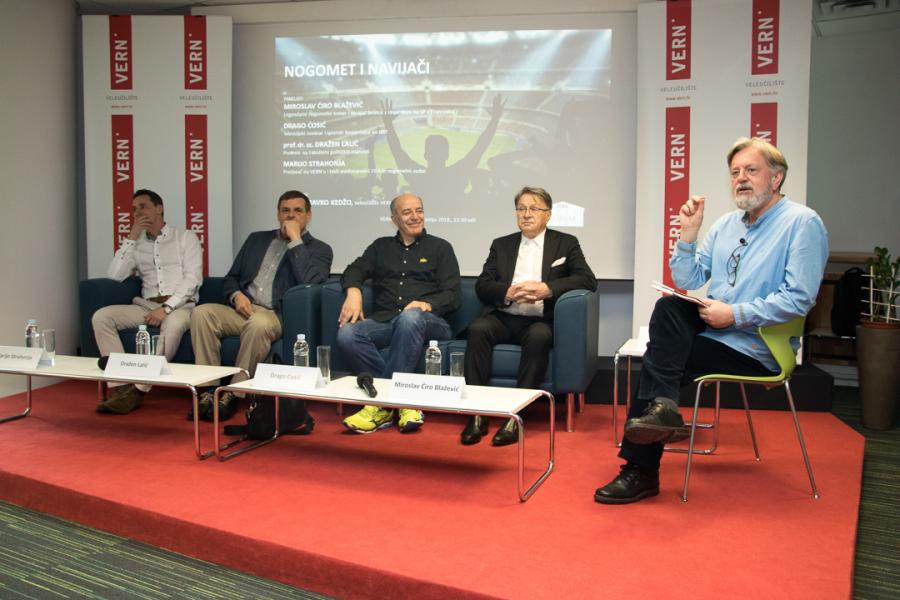
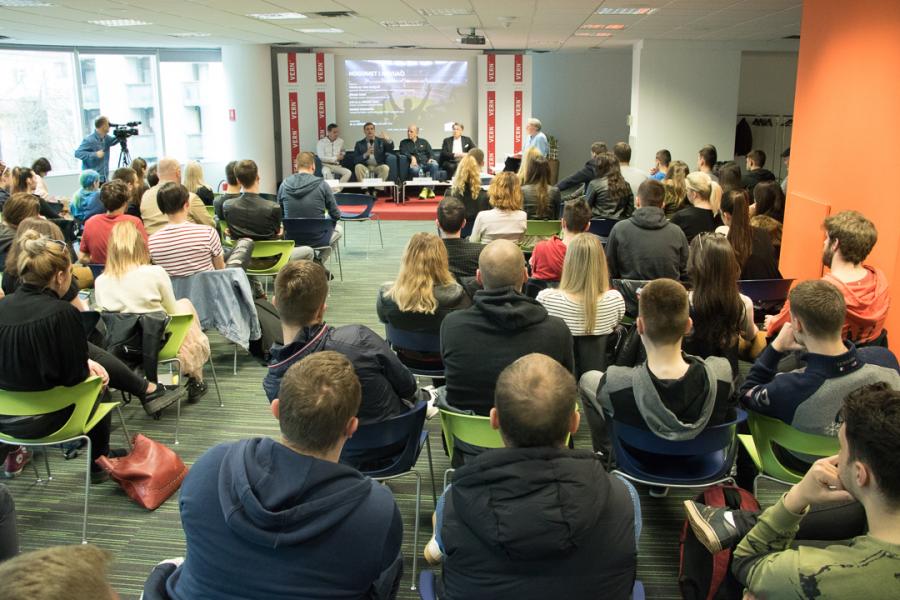
Fans are indirect actors in sports, along with other direct audiences, players, coaches, referees and the media, and without them, sporting events have no real meaning, it was emphasized at the panel "Football and Fans" , which was held in anticipation of the World Cup in Russia and organized by VERN' University.
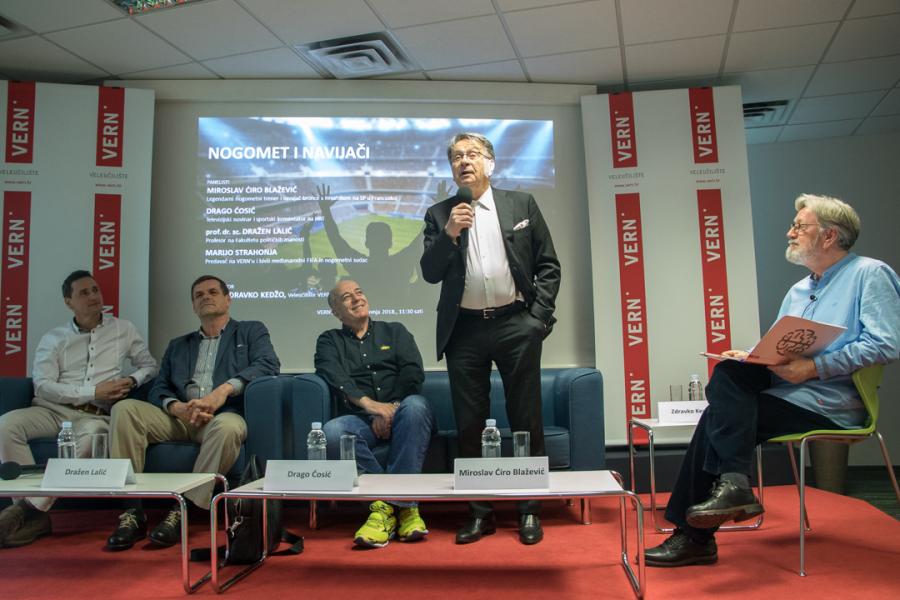
The panel was opened by the head of VERN' Forum, Dr. Ozana Ramljak , and the inextricable link between football and fans, the social aspect of this phenomenon, the local and national dimension of cheering, and the role of the media in the relationship between football and fans, as well as in creating a public image of cheering and fan groups, were discussed by former football coach Miroslav Ćiro Blažević , a television journalist and sports commentator on HRT Drago Ćosić , sociologist and professor at the Faculty of Political Science in Zagreb Prof. Dr. Sc. Dražen Lalić and Marijo Strahonja , lecturer at VERN' and former international FIFA football referee.
The panelists pointed out that fan behavior is deeply rooted in modern society, and fan habits develop on a personal level during each individual's upbringing. Therefore, it is not surprising that the theory of studying this phenomenon of the connection between sports and fans also includes the term "willingness to sacrifice" .
"Members of fan groups, especially core members of fan groups, are especially ready to sacrifice. For them, cheering for a club or national team is the meaning of life, because they are not only cheering for the club, but for the values that the club represents and thus express their belonging to an identity, culture, homeland and emotions, and through traveling and cheering, they gain rich life experiences" , stressed Prof. Lalić .
The most direct actor in relations with fans, former football coach Ćiro Blažević, argued that fans are the meaning of the game and the spiritual support for the players, and that without them, or in front of empty stadiums, the game itself no longer makes sense. Just like without the presence and cooperation with the media. "Journalists are the soul of the audience and football players should not hold it against them, because they are intermediaries between the players and the fans. If the players do not feel that the audience supports them, their performance is weaker," he said.
Drago Ćosić characterized the specific mediating, but also educational, role of the media in the relationship between football and fans, especially from the perspective of combating violent behavior, as a "curse".
"The media is a curse because through the depiction of fan riots, in a few days they can create heroes out of those same thugs, completely unintentionally, only wanting to show what happened on the field. That's why we avoid such scenes as much as possible, and the decline in fan riots at matches is closely linked to the decline in the number of spectators," Ćosić pointed out, adding that he believes that Croatian fans in Russia will be disciplined because the Russian police will isolate all the offenders registered so far.
The coexistence of football and fans was analyzed from a referee's perspective by former FIFA referee Mario Strahonja , who six years ago made history in Croatian football as the first referee to stop a match due to a flare.
"I was just respecting the rules of the game and the three steps prescribed by UEFA and the Croatian Football Federation. After the third warning was violated, I decided to stop the match, regardless of the audience's reaction," Strahonja recalled, mentioning that some matches in Croatia were not stopped even after four referee warnings.