During the conversation, students had the opportunity to learn more details about the sustainability of cultural journalism in today's media environment.
In the contemporary media landscape, cultural journalism, i.e. newspaper reporting in culture, occupies a special place, but it faces numerous challenges. As part of the course on Thematic Reporting , professor Ph.D. Marije Slijepčević, third-year students of VERN's undergraduate study of Journalism had the opportunity to learn about the key aspects of this specialized field.
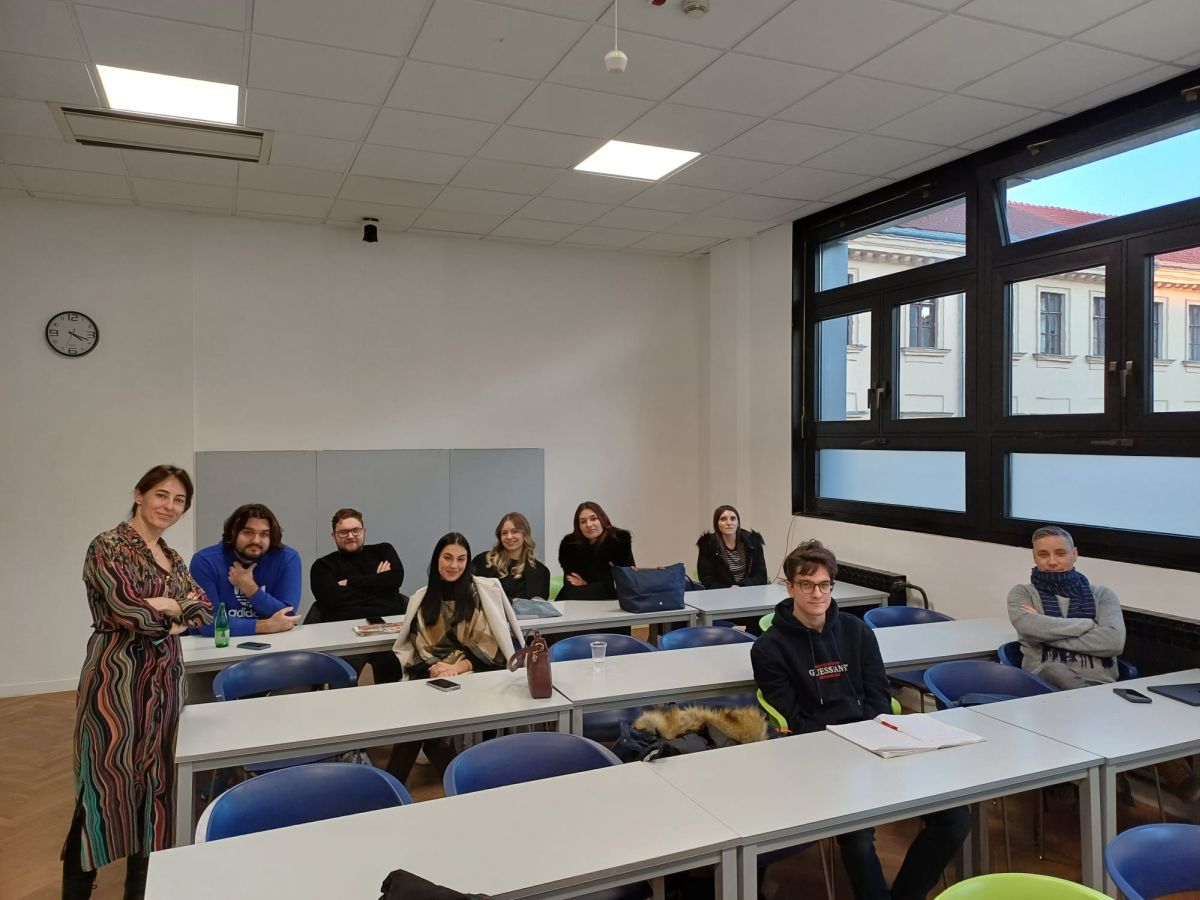
Gea Vlahović , a long-time journalist with extensive experience in sectoral journalism, and culture editor at Telegram, shared her thoughts on this specific field with our students, emphasizing that expertise, precision, and passion for the job are extremely important.
Sectoral journalism - the pinnacle of professionalism
She pointed out that specialized journalism, for her personally, represents the pinnacle of professionalism. Cultural topics such as architecture, music, literature or pop culture require journalists with a deep understanding and dedication to the field they are writing about. Such a level of specialization does not come by itself, but is built over years, through continuous research and investment in one's own skills.
Although the market in Croatia is small, Vlahović highlighted bright examples of independent media dealing with culture, such as the portals Glazba.hr and Kazalište.hr , but they often operate on a project basis and outside the mainstream framework. Vlahović singled out Croatian Radio and Television as the largest institution with the capacity to seriously monitor culture, as it is the only media outlet with the resources for such reporting, but also indicated that the number of such specialized journalists in Croatia is limited.
Valuable experience
The lack of journalistic personnel in culture is also noticeable in the Croatian reporting news agency, which once employed as many as eight sector journalists, but today there are only three of them. She added that few people dedicate themselves to this work, and once they have mastered the skills of agency reporting, they have all the predispositions to work in global agencies such as Reuters and the Associated Press .
On the other hand, there are examples like Telegram, which is funded by subscriptions, and precisely because of this fact it has to produce high-quality and large-scale feature articles on culture that will attract the attention of an audience that appreciates quality journalism. In contrast, mainstream topics in culture attract a wider audience, but also require careful filtering to satisfy the interests of readers.
Inspiration for the future
Despite all the challenges, sectoral journalism has a future, Vlahović emphasized. Greater investments and continuous education of journalists are needed to preserve the quality of reporting on culture. Culture as a topic will always have its audience, and journalists need to know how to attract readers with relevant and interesting content.
This conversation provided students with a deeper understanding of the key challenges and potentials of this field, as well as the importance of continuous investment in knowledge, professionalism and creativity. They also became aware of the real conditions in which sectoral journalism takes place, which provides them with a basis for their own professional development.
(collaborator: Marinela Mesar)